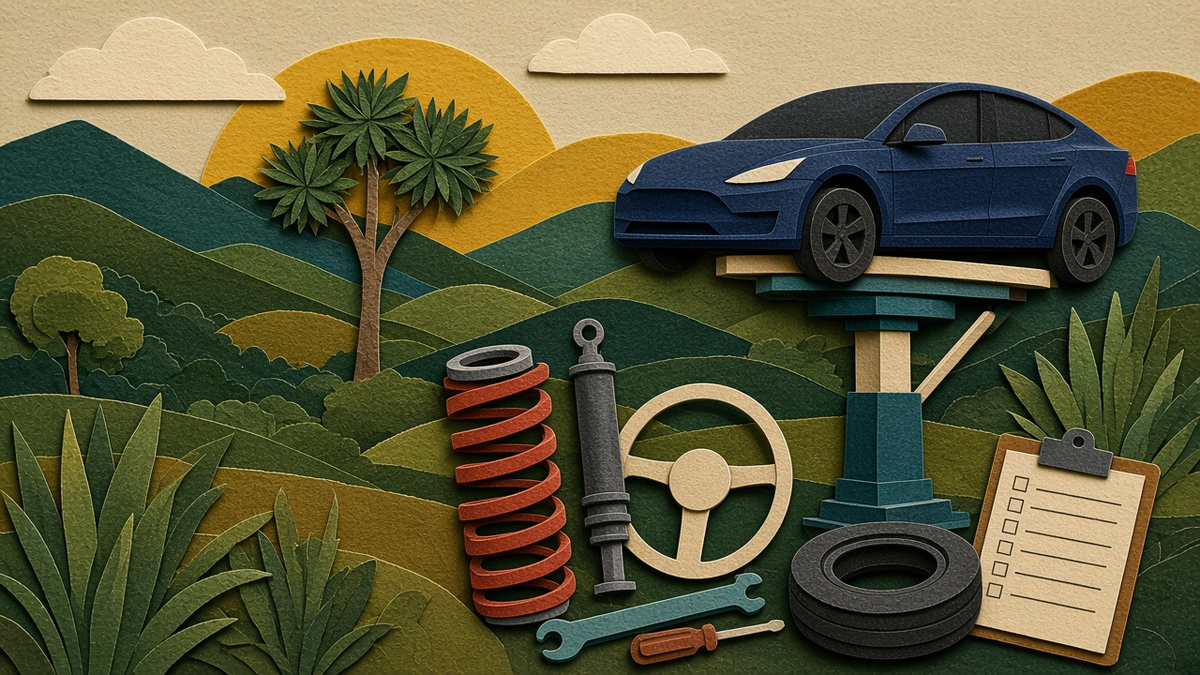
Steering and suspension problems are the main reason Teslas fail their warrant of fitness (WoF) in New Zealand, accounting for almost a third of all Tesla failures, according to NZ Transport Agency (NZTA) data obtained by RNZ's First Up.
RNZ reported on 23 November that the comparable figure for suspension failures was 8% for Nissan EVs and 6% for BYD vehicles.
The data also showed a big difference depending on who did the inspection. Tesla's own service centres failed 15% of the Teslas they inspected, compared with a 31% fail rate at VTNZ.
Is there a problem with Tesla's design?
NZTA says no. Its head of vehicle regulation, Geoff Williamson, told RNZ the agency was aware of Tesla's higher-than-average WoF fail rate for steering and suspension, but did not have concerns over the design of those systems.
He said the higher failure rate was mainly associated with "a well-known suspension wear issue affecting some Teslas", and that the company had a warranty replacement programme for those cars. NZTA had not received formal complaints specifically about Tesla's steering and suspension design, and was watching international investigations, recalls and complaint data to see whether any action was needed in New Zealand.
In the United States, the Department of Transportation opened a preliminary investigation after receiving 156 complaints alleging suspension failure in Tesla vehicles, RNZ reported.
Tesla did not respond to RNZ's request for comment.
Why would Teslas fail more often?
Jeff Smit, founder of the EV & Hybrid Network in Australia, who runs a Sydney workshop specialising in EVs and hybrids, told RNZ he saw no particular issue with Tesla's suspension compared with other makes. But he said the data showed Teslas were not serviced as often as other cars, and that Tesla drivers tended to drive more aggressively.
Tesla says on its website that it designs its vehicles with the goal of eliminating the need for service. Nissan and BYD say their vehicles should be serviced every 20,000km or every 12 months, according to RNZ.
As for the gap between Tesla and VTNZ inspections, VTNZ said in a statement that different manufacturers had specific tolerances and requirements for their steering and suspension components.
What does this mean if I own one or am buying one?
A failed WoF isn't a fine. It means the car needs repairs before it can get a new warrant. If your WoF expires, though, you can be fined for driving without a current one.
If you own a Tesla:
- Ask about the warranty programme. If your car has the suspension wear issue NZTA referred to, contact Tesla before paying for repairs yourself. Keep records of any knocking, clunking or uneven tyre wear.
- Get it checked before the WoF is due. Worn suspension parts often show up as uneven tyre wear or noises over bumps. Fixing them before the inspection saves a second trip.
- Don't skip servicing just because it's an EV. EVs have fewer moving parts in the motor, but they are heavy, and tyres, suspension, brakes and steering still wear.
- Keep your paperwork. If you think a fault should be covered, the Consumer Guarantees Act says cars sold by a dealer must be of acceptable quality and last a reasonable time, depending on price, age and use.
If you're buying a used Tesla, ask for its WoF history and any repair or warranty records, and consider a pre-purchase inspection. You can check a vehicle's WoF expiry date and recall information through NZTA's online tools.
Where can I check the rules?
NZTA's website explains how often your vehicle needs a WoF, which depends on its age, and what is checked. The latest NZTA data obtained by RNZ has not been published on NZTA's own site.
For more on driving costs and rules, see our story on average speed cameras now enforcing in Hawke's Bay and Auckland, and what Stats NZ's fuel price figures show if you're weighing up an EV against a petrol car.