
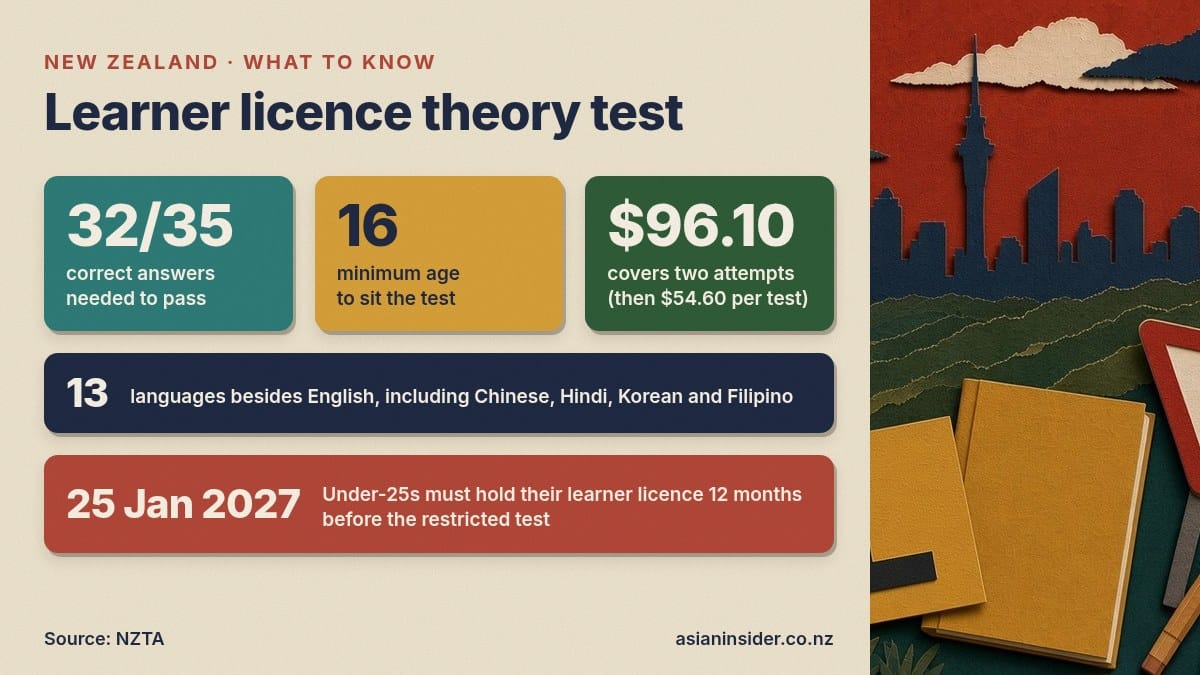
You have to be at least 16 to apply for a car learner licence, and you can't get one without passing a computer-based theory test on the road rules, NZ Transport Agency Waka Kotahi (NZTA) says.
Rules for what comes after it change on 25 January 2027, which matters if you are under 25.
Booking and what to bring
You don't book the theory test online. NZTA says you apply for your learner licence in person at a driver licensing agent, and the agent books your test at the same time. It may be straight away, so NZTA advises learning the road rules before you go in.
At the agent you fill in a DL1 application form, show ID, pass an eyesight check, and have your photo and signature taken. NZTA says you can do the eyesight check at an optometrist instead.
For ID, NZTA accepts a current New Zealand passport, a New Zealand birth certificate together with a student ID, or two other acceptable forms of ID from its list.
The learner licence application fee is $96.10, according to NZTA. That covers your first theory test and a second one if you need it. From the third attempt, each test costs $54.60.
NZTA says to arrive at least 10 minutes early. If you are late, you might not be able to sit the test that day.
The test itself
NZTA says the test is 35 multi-choice questions on a computer, a mix of general Road Code questions and questions specific to driving cars. You need at least 32 right, which means a fourth wrong answer is a fail.
Questions come up in random order. You can change an answer while you are on that question, but it is locked in once you move on. NZTA's Drive website says each question has two or four options and the questions are drawn from a bank of about 200.
Besides English, NZTA says the test is available in Arabic, Chinese (simplified and traditional), Fijian, Filipino, Gujarati, Hindi, Korean, Māori, Punjabi, Samoan, Thai and Tongan. People with reading difficulties can ask for extra time or to have the test read to them. If your language isn't offered, NZTA says you may be able to use an interpreter. Tell the agent when you book.
The Road Code says the test covers road rules, hazards and safe driving practices.
Practising in your own language
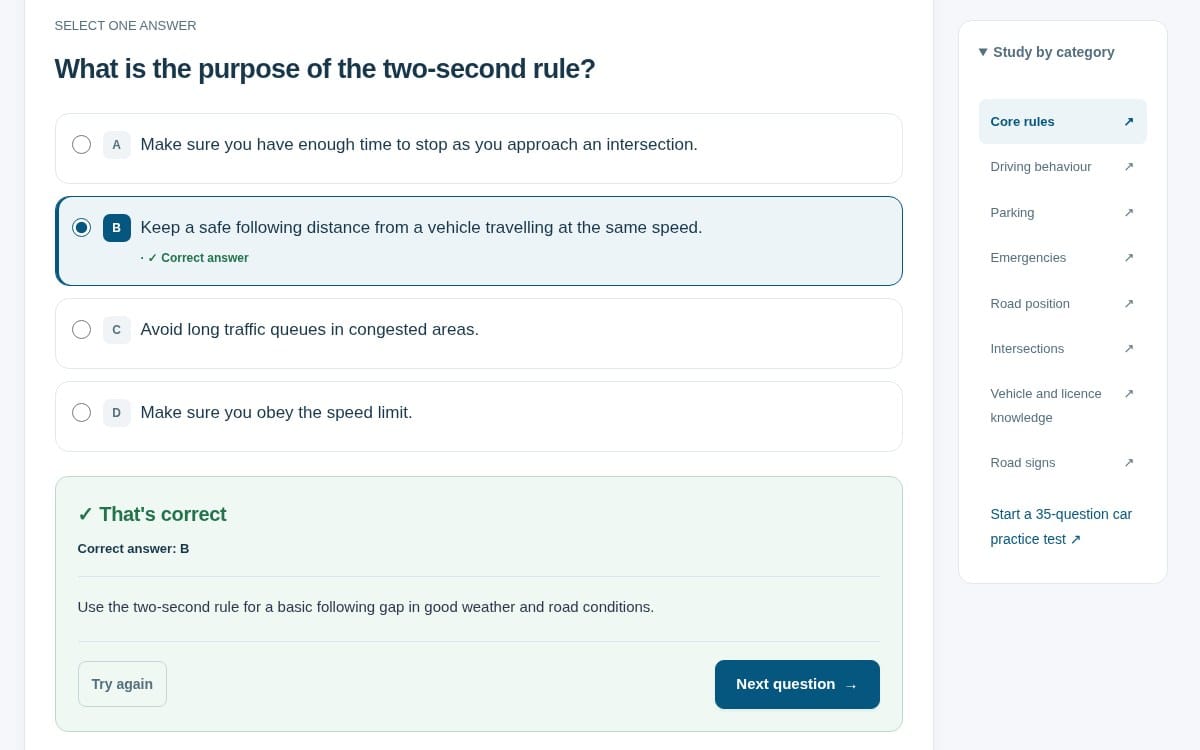
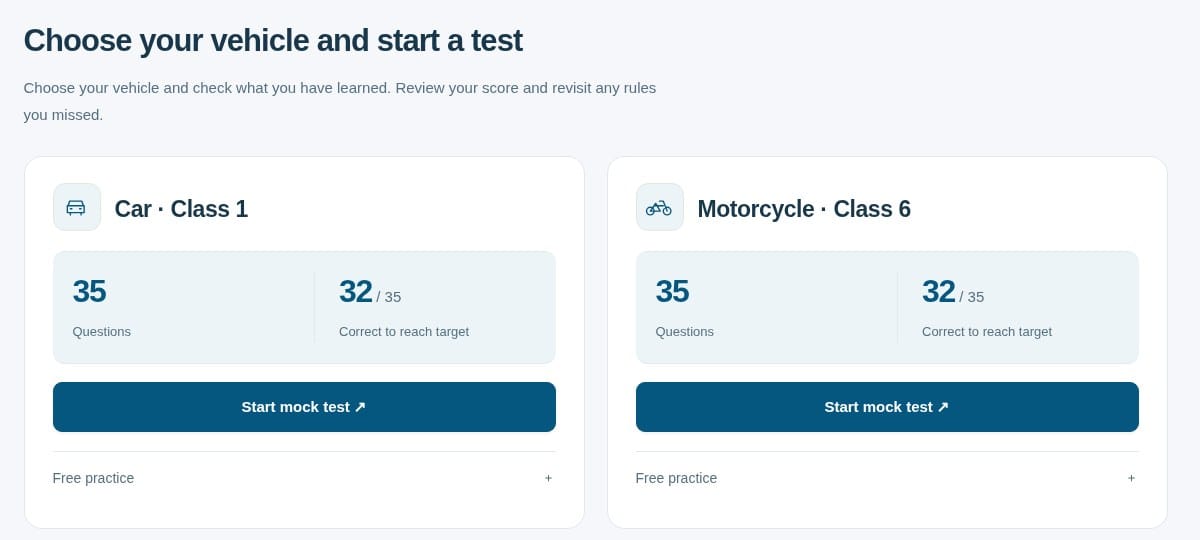
If you want to practise in a format like the real test, GO Drive is a free website with mock tests of 35 questions and a car pass mark of 32, the same as the NZTA test. It also has shorter sets of 10, 20 and 50 questions. You don't need an account or a login, and there are no ads.
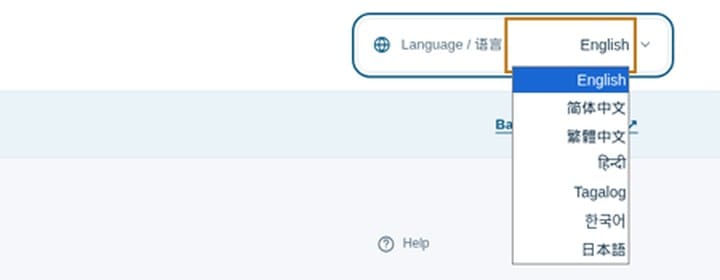
GO Drive is available in English, Simplified Chinese, Traditional Chinese, Hindi, Tagalog, Korean and Japanese. It says its questions are designed for practice and are not the official exam paper, so use it alongside the Road Code rather than instead of it.
If you fail
You can book another test at the agent. If you fail twice on the same day, NZTA says you must wait 10 working days before trying again.
Once you pass
The agent gives you a temporary learner licence valid for 21 days, and the photo card is posted to you. The learner licence is valid for 10 years.
NZTA says on a learner licence you must not drive alone. A supervisor has to sit beside you, and L plates must be shown on the front and back of the car. You can carry passengers only if your supervisor agrees, and you must carry your licence.
A supervisor must hold a current full New Zealand licence, must not have a supervisor condition on it, and must have held a full New Zealand licence, or an equivalent overseas one, for at least two years, the Road Code says.
Driving without a supervisor carries 35 demerit points and a $100 fine. Not displaying L plates carries 25 demerit points and a $100 fine, according to NZTA.
The 2027 change
From 25 January 2027, under-25s will have to hold a learner licence for 12 months, not six, before they can sit the restricted test, NZTA says. Anyone under 25 who got their learner licence on or after 25 July 2026 already falls under the 12-month rule.
Those who got their learners before 25 July 2026 still need six months, but if they haven't got their restricted by 25 January 2027, their minimum learner period becomes 12 months.
NZTA says under-25s will be able to cut the period back to six months by completing an approved learner licence course or by logging supervised driving hours, which will be up to 60 hours. We covered the change in more detail here.
How to study
NZTA says everything you need to pass is in the official New Zealand Road Code. The car Road Code is free to read on NZTA's website, and printed copies are sold at most bookstores and driver licensing agents.
NZTA also publishes theory test questions on its Road Code site, grouped by topic and linked to the section that explains each answer. The Drive website lets you practise the official theory test online, and has a "tough words" test for terms that may come up.
Some areas need closer reading than others. The give-way rules for intersections, roundabouts and turning traffic take time to learn properly, and the Road Code works through them with diagrams. Signs and road markings are another section worth going over carefully.
Following distance is a direct question in NZTA's published practice questions. The Road Code says to use the two-second rule in normal conditions, and four seconds in bad weather, on wet or slippery roads, or when towing a trailer.
Sources
- NZTA, How to get a learner licence
- NZTA, Theory test for learner licence
- NZTA Road Code, Stage 1 – learner licence
- NZTA Road Code, Stage 2 – restricted licence (supervisors)
- NZTA, Test fees
- NZTA Road Code, Following distance
- NZTA Road Code, theory test questions
- Drive, What happens during the learner licence test
- Drive, Practice tests