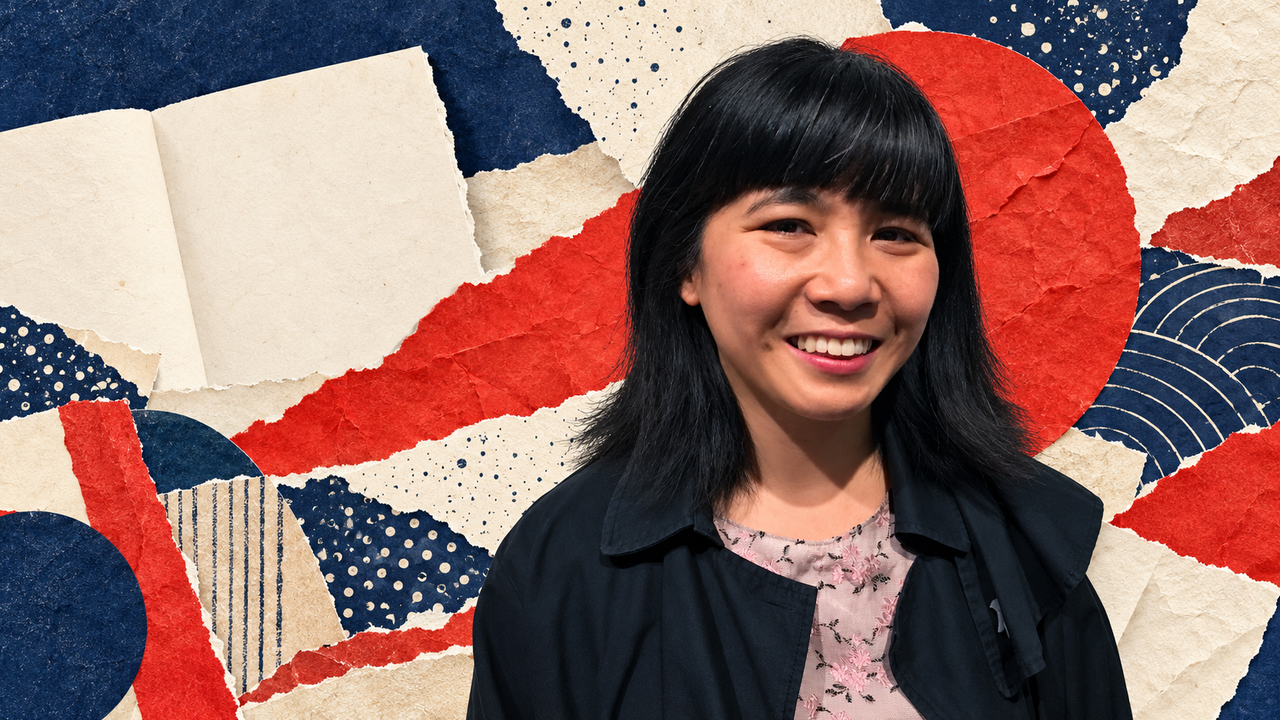
A set of old printing blocks can be more than an object to preserve. In Kerry Ann Lee’s hands, it becomes material for another artist’s experiments, another generation’s questions and another way of seeing Chinese New Zealand history.
That approach was visible in A Chop That Breathes, her exhibition at Objectspace in Auckland from 27 March to 31 May 2026. The exhibition has ended, but its combination of inherited materials and new forms offers a useful introduction to Lee’s wider practice. Her work asks what happens when cultural memory is handled, rearranged and made active again.
In conversation with another generation
For A Chop That Breathes, Lee worked with letterpress elements once owned by the artist Guy Ngan. His daughter, Liz Ngan, had given the materials to Wai-te-ata Press. Lee used traditional printmaking and digital tools to develop compositions from those forms, with animation adding movement beyond the printed page.
The connection was also personal in a cultural sense. Objectspace identifies Lee and Ngan as artists from Wellington who share Cantonese heritage and a connection to the Wellington School of Design.
The project suggests a generous way to approach an artistic legacy. Keeping an earlier artist’s materials in use can create a conversation rather than a fixed monument. New compositions need not reproduce the original work to acknowledge the person who made them possible.
Looking again at the museum collection
An earlier project, Return to Skyland, brought Lee into dialogue with Te Papa’s collections. Created in 2018 in response to the museum’s Terracotta Warriors exhibition, it included the video Distant resonance. According to Te Papa’s collection record, the video drew on images of 62 Chinese objects in the museum’s collection, alongside found imagery and lines from a poem by Rewi Alley.
This is a different kind of encounter with an archive. Rather than presenting each object only as a discrete historical specimen, an artist can make relationships between images newly visible. The resulting work invites viewers to consider both what institutions collect and how those collections can be interpreted.
Te Papa describes Lee’s practice as exploring cultural intersections and Cantonese Chinese settlement in New Zealand and the Pacific. That framing connects the museum project to a longer investigation of identity and place.
A practice that travels across formats
Lee’s work extends beyond a single medium. Massey University’s staff profile identifies her as an associate professor, while Objectspace describes a practice spanning art, design and publishing. Teaching and making sit within the same professional life.
A 2011 Wellington City Council release also records her participation in the Wellington Asia Residency Exchange in Shanghai. It explicitly identifies her Chinese New Zealand background and discusses the experience of working across national settings. Such exchanges complicate the idea that heritage is a single, settled place to which an artist simply returns.
Leaving room for play
Lee’s work is particularly useful for audiences accustomed to encountering Chinese New Zealand history primarily through hardship and exclusion. Those histories matter, but artistic expression also needs room for curiosity, experiment and pleasure.
Seen across the two exhibitions, her method allows inherited objects and institutional collections to become starting points. The past remains present, while new arrangements make space for experiences that a conventional timeline might miss.
Prepared on 25 October 2026 from the linked public sources. This is a source-based profile, not an original interview.