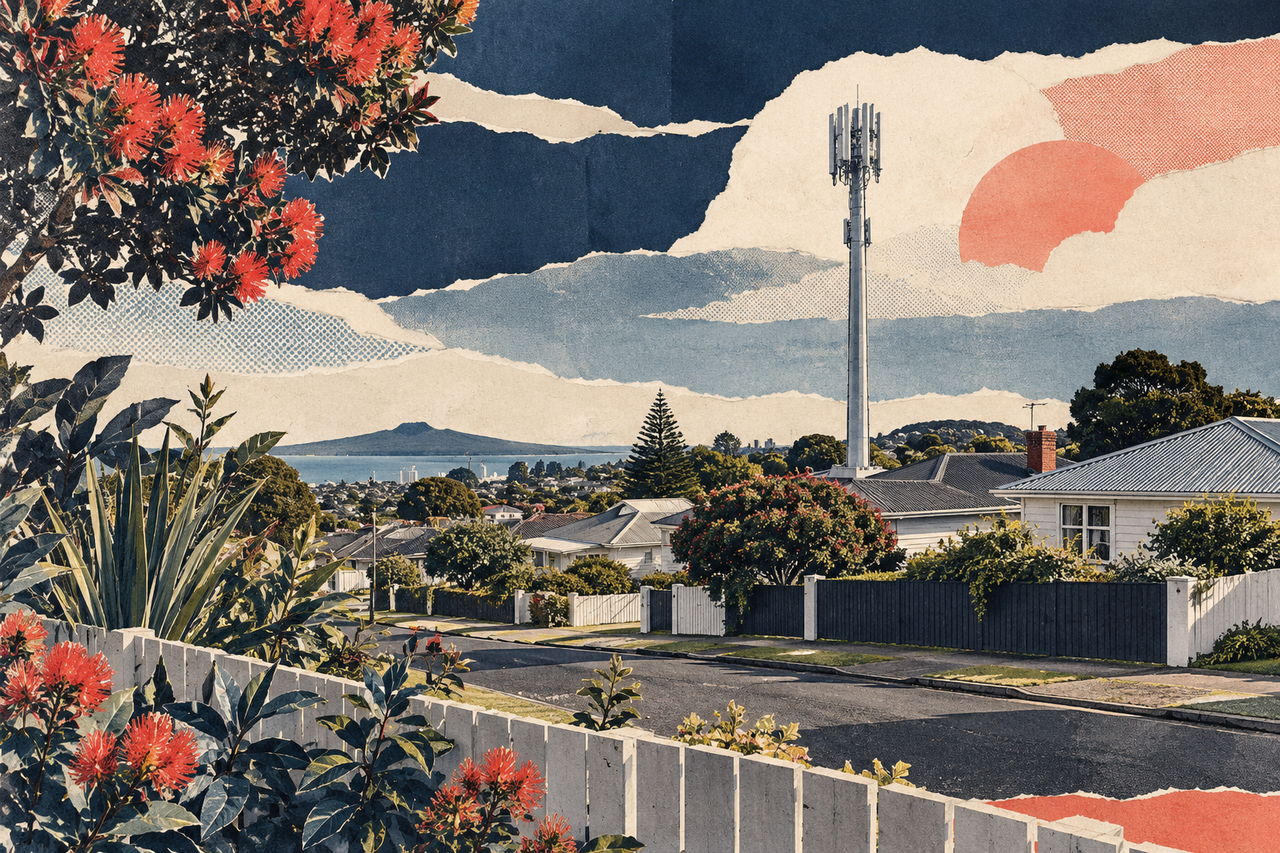
Some Auckland households have learned that substantial mobile-phone towers are planned near their homes without the public-consent process they expected. Their frustration has brought a recent national planning change into everyday suburban life.
RNZ’s 29 October report describes proposed 16-metre and 17-metre towers in Torbay. Residents questioned the lack of consultation and the visual effect. Concerns about property values were residents’ concerns, not measured losses established by the report.
The network operators’ argument
Connexa told RNZ that more sites were needed within the communities using the network. Spark described demand shifting from calls and texts towards data-intensive activity. That explains the operators’ case for expansion, while leaving the residents’ questions about particular locations unresolved.
Connexa distinguished a formal statutory notification process from community engagement. It said construction on the Torbay towers was planned for late November. Those were proposed works at the time of the report, not structures Asian Insider has observed being completed.
Permitted does not mean without standards
The government’s telecommunications standards page confirms amended regulations took effect on 8 October 2026. The stated aims include network resilience, infrastructure sharing and more consistent deployment rules, while retaining controls for sensitive areas.
The framework covers different kinds of poles, antennas, cabinets and lines, with conditions that vary by activity and setting. It also incorporates radiofrequency and environmental-noise standards. A headline about easier construction should not be read as permission for any tower, anywhere, regardless of its design.
Questions about a particular site
A resident can ask which activity and standards the proposal relies on, where the structure and cabinets would sit, and what information the operator has supplied to the council. Those details are more useful than assuming every application follows the same consent route.
There is also a documentation trap: the government page says its 2018 users’ guide does not cover the 2026 amendments. Anyone checking a new proposal should make sure the guidance they are reading includes the current changes.
Sources: RNZ’s resident interviews and operator responses, and official NES-TF guidance, checked 29 October 2026. This article does not assess compliance at any individual property.