Adapted from KanNZ, with propagation and New Zealand growing advice checked on 11 October 2026.
If you like the fruit from an established feijoa, taking cuttings is one way to try growing more plants from it. The Royal Horticultural Society lists semi-ripe cuttings as a propagation method for feijoa. Success depends on the material and care; a fixed promise that roots will appear in ten or fifteen days is not a useful expectation.

Start with the right growth
Semi-ripe growth has a firm base and a softer tip. The RHS’s general guidance describes taking this material from the current season’s growth. Its calendar references are for the UK; New Zealand gardeners should follow local summer growth and conditions rather than copying Northern Hemisphere months.
Choose healthy shoots and clean, sharp tools. Prepare your pot, rooting medium and labels before cutting. A label with the parent plant and date helps you compare attempts without guessing later.
Prepare the cutting
- Take healthy, non-flowering material. Keep it from drying out while you work.
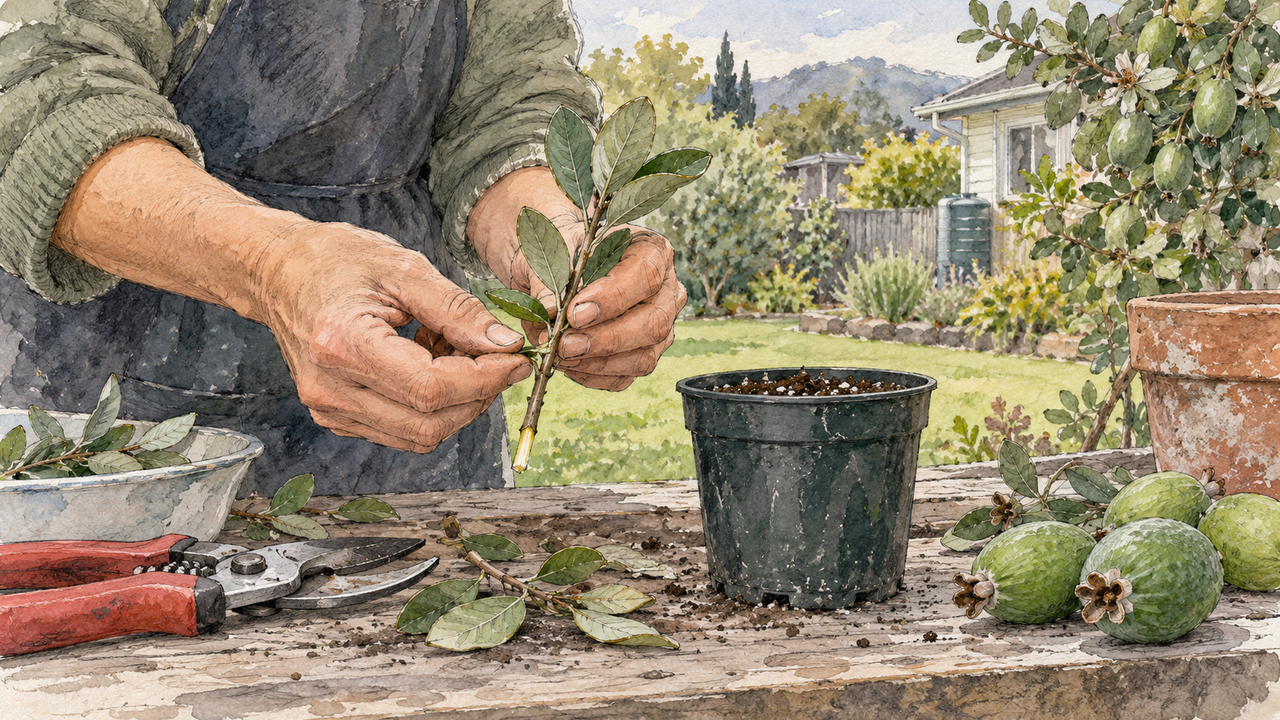
- Prepare a cutting about 10–15 cm long, cutting below a leaf node. Remove lower leaves and the soft tip as described in the RHS’s general semi-ripe method.
- Use a suitable rooting hormone according to its label if you choose to use one.
- Insert the prepared cutting into a pot of free-draining propagation medium, keeping the remaining leaves clear of the surface.
These are general semi-ripe cutting steps, rather than a guarantee of success for every feijoa cultivar. For a valuable named variety, ask a nursery for advice before relying on one cutting.
Care while roots develop
The RHS advises a humid environment, such as a covered pot, in good light away from direct sun. Keep the medium moist without leaving it waterlogged. Ventilate the cover and remove failing material so it does not sit against healthy cuttings.
A new leaf alone does not tell you the plant has a strong root system. General RHS propagation guidance recommends potting on once roots are well established and the plant is growing. Acclimatise it gradually to outdoor conditions; do not move a protected cutting straight into a hot, exposed position.
Choose a place for the young plant
Tui’s New Zealand growing guide recommends a sunny position with free-draining soil. Autumn and spring are useful planting seasons in many areas; in cold districts, wait until the soil warms and frost risk eases.
Consider the variety and available space before planting. Feijoas can be grown in containers as well as garden beds. Tui recommends at least two different varieties for better cropping, including where a variety is described as self-fertile.
Water deeply during dry periods, particularly while fruit is developing in mid to late summer. Mulch helps retain moisture. Follow fertiliser instructions rather than treating a young cutting like an established fruiting tree.
Harvest and expectations
Let fruit mature before collecting it. Tui describes gently cupping a fruit and checking whether it releases easily; one that remains firmly attached is not ready. Growing a cutting is a longer project than buying an established nursery plant, so keep the first goal small: a healthy rooted plant that survives its first move outdoors.