Auckland Council says households will not be made to swap their rubbish bins for smaller ones, after last week's vote on an 80-litre default bin caused confusion.
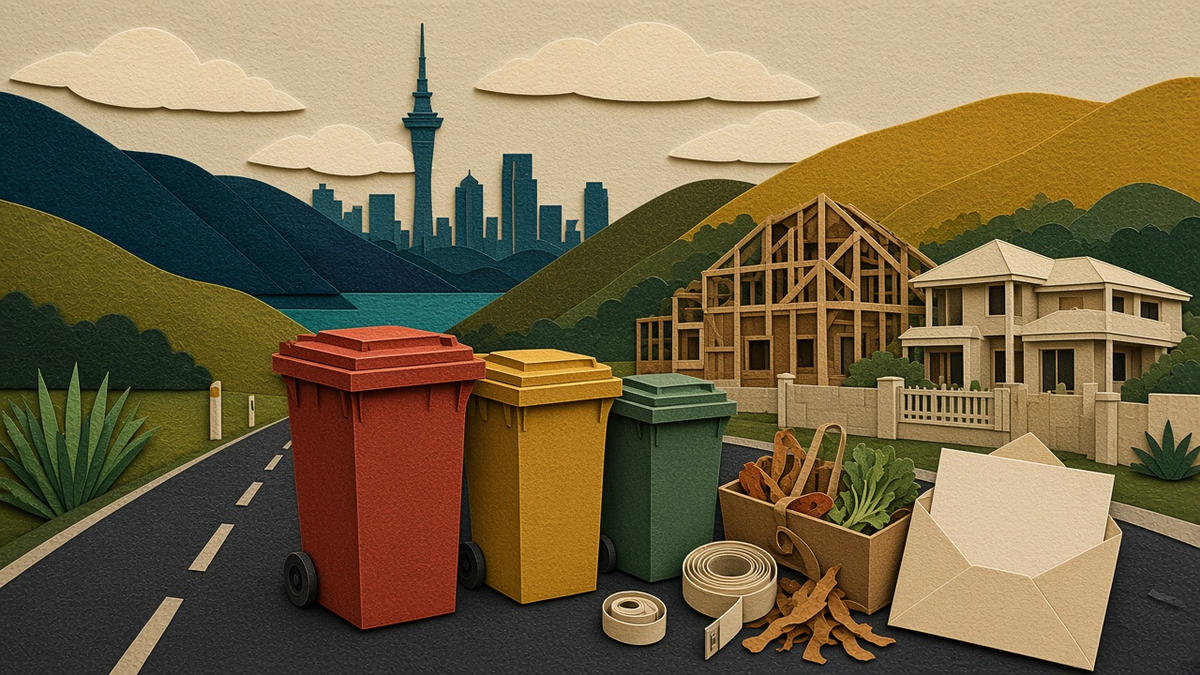
In a "myths vs facts" article published on 13 November, the council said the 80-litre default agreed by its Policy, Planning and Development Committee applies to new properties. If you already have a rubbish bin, it stays the same unless the ratepayer asks for a different size.
"Your current rubbish bin, collection service and charges are not changing as a result of this decision," the council said.
What did the council actually decide?
According to the council, the committee:
- changed the default rubbish bin size for new properties to 80 litres. Ratepayers of new properties can still order a different size. If they don't choose one, they get an 80-litre bin.
- supported staff looking at the price differences between bin sizes. The council says this work will "take some time" and has to be done before any decision to consult.
- agreed on what it calls a targeted approach to getting more people to use the recycling and food scraps services they already have.
The council says it is not replacing or downsizing existing bins across Auckland, and the range of bin sizes on offer is not changing.
Are bin charges going up?
Not now. The council says "no decisions have been made on pricing changes", and that if any are proposed, Aucklanders will get a chance to have their say first.
That is the main point of difference from early reporting. When the committee voted on 10 November, The Post reported indicative charges from a council staff paper, including $69 to $119 a year for an 80-litre bin and $438 to $488 for a 240-litre bin. Those numbers were not decided. Under the council's explanation, any change to prices would need more staff work and then public consultation.
We reported those indicative figures in our earlier article on the 80-litre bin vote.
Is weekly collection changing?
No. The council says weekly rubbish collections continue.
Why is the council pushing food scraps and recycling?
The council says Auckland needs to cut the amount of waste going to landfill, and that every tonne sent there has a cost.
It says Aucklanders have sent 74,000 tonnes of food scraps through the kerbside food scraps service, which is turned into liquid fertiliser and energy. It also says 35 percent of what is in Aucklanders' rubbish bins is organic waste.
"So the food scraps service certainly works, we just need more Aucklanders to use it," the council said.
What does this mean for my household?
If you own your home and already have a bin: nothing changes unless you ask for a different size. You keep the same weekly collection and the same charge for now.
If you are buying or building a new home: an 80-litre bin will be the default for new properties. If your household needs more space, for example a large or multigenerational family, the ratepayer can order a bigger size instead.
If you rent: the bin size is requested by the ratepayer, which is usually the landlord. The council's statement doesn't change that. If the bin isn't big enough for your household, raise it with your landlord or property manager. Our article on how often rent can go up covers your rights on rent increases.
If you want to reduce what goes in the red bin: the council's own figures suggest food scraps take up a large share. Using the food scraps caddy and recycling bin properly is the simplest way to fit rubbish into a smaller bin, whatever size you have.
When could prices change?
No date has been given. The council says staff will look at price differences across bin sizes and that this work will take time. Any proposal on pricing would then go out for public feedback before a decision is made.
Larger households, which tend to fill bigger bins, may want to watch for that consultation. Auckland Council usually publishes consultations on its "Have Your Say" website.